

Silk Road
Through the so-called Silk Road, China maintained continuous relations—particularly commercial ones—with Central Asia and, further west, with regions of Persian culture. These exchanges were reinforced by the political fragmentation of Northern China, especially following the end of the Jin dynasty in the 4th century, when new foreign dynasties—such as the Wei and later the Qi—established themselves. These dynasties fostered not only trade but also the introduction of new forms, ideas, and beliefs, including Buddhism.
Silk was the most sought-after Chinese luxury commodity; conversely, metalwork—particularly involving precious metals like gold and silver—was highly coveted by the Chinese, given the superior quality and sophistication of craftsmanship found in Central Asia and Persia.
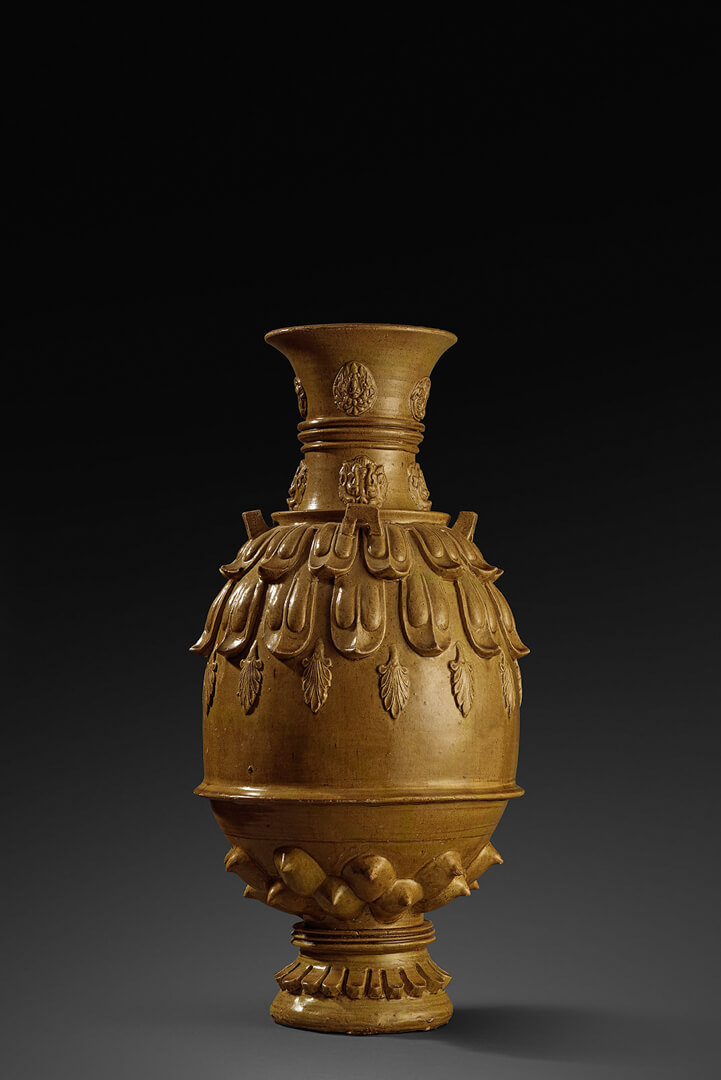
Large Buddhist inspired vase
This large vessel, characterized by sophisticated workmanship and essentially non-Chinese decoration, was produced in this context during the Northern Qi period (550–577). It features a raised base, a distinct shoulder, and a tall neck, with elaborate ornamentation inspired by vessels, vases, and dishes made of gold and repoussé silver. It is worked in high relief with large lotus petals, palmettes, monster masks, and depictions of Buddhas and celestial beings—motifs drawn from Sassanid Persia, the Eastern Mediterranean, and Buddhism via the Gandhara region.
Its creation required the application of new modeling and firing techniques. Stoneware production, previously somewhat limited, underwent significant development in Northern kilns during this time, thanks to the use of higher firing temperatures. The glaze on this piece displays a rare hue somewhere between amber and olive green.